Your AC just quit in the middle of a Florida heatwave, and you need help NOW—but can you really get same day HVAC repair in St. Cloud?
Yes—and here's what we've learned after years of actual emergency calls in St. Cloud makes that possible.
Living here in Central Florida myself, I've responded to hundreds of these urgent situations. What most homeowners don't realize is that same day service in St. Cloud isn't just about availability—it's about proximity. We're talking about a city where most residential areas sit within a 20-minute radius of qualified HVAC contractors, which changes everything when you're dealing with an emergency.
On this page, you'll discover insights we've gathered from real service calls:
The three types of failures we consistently fix same day (and the two that typically can't wait until tomorrow)
Why St. Cloud's compact geography actually works in your favor for emergency response
The honest timeline from your phone call to a running system—based on what we've seen, not marketing promises
Red flags we've noticed about companies that claim "immediate" service but consistently run 6+ hours late
The simple preparation step that cuts average repair time by 30 minutes (something we wish every customer knew before we arrived)
After diagnosing everything from compressor failures during Fourth of July weekend to refrigerant leaks on Christmas morning, we've developed a clear picture of what "same day" actually means in our Central Florida market. Most companies won't tell you this, but response time varies dramatically based on factors you can actually control—and we're going to walk you through exactly how this works in St. Cloud.
TL;DR Quick Answers
HVAC Repair in St. Cloud
Yes, same day HVAC repair is genuinely possible in St. Cloud for most common failures.
Best response times:
Call before 2 PM weekdays: 3-4 hour response typical
Emergency situations with vulnerable populations: 90-minute to 2-hour response
After 5 PM or weekends: 4-6 hours with premium pricing (1.5-2x normal rates)
What gets fixed same day:
Electrical failures (capacitors, breakers, fuses)
Thermostat problems
Clogged condensate drain lines
Dirty air filters causing shutdowns
What typically can't be fixed same day:
Compressor failures (2-5 days for parts)
Major refrigerant leaks
Specialized blower motor replacements
St. Cloud advantage:
Compact geography means most homes within 15-20 minutes of multiple contractors
Competitive market keeps response times short and pricing reasonable
Before calling for repair:
Verify contractor license at MyFloridaLicense.com (takes 60 seconds)
Check for active CAC or CMC license
Confirm system age and recent symptoms
Determine if genuine emergency or can wait for standard rates
Cost expectations:
Diagnostic fee: $75-125 weekdays, $150-200 after-hours
Simple repairs: $150-300
Mid-level repairs: $400-800
Major repairs: $1,200-2,500
Smart decision: Establish contractor relationship during mild months (not during emergency) for prioritized service when you actually need it.
Top Takeaways: Same Day HVAC Repair in St. Cloud
1. Same Day Repair Is Possible—But Timing Determines Success
Call before 2 PM weekdays for best response (3-4 hours typical)
Common fixes: electrical issues, thermostat problems, clogged drains
After 5 PM or weekends: tighter windows, 1.5-2x higher costs
2. Some Problems Can't Be Fixed Same Day (And Honest Contractors Admit This)
Compressor failures: 2-5 days for parts
Major refrigerant leaks: typically multi-day repairs
Specialized blower motors: next-day at minimum
Red flag: contractors promising same day for everything without seeing your system
3. Verify Every Contractor's License First (Takes 60 Seconds)
Use MyFloridaLicense.com before anyone touches your system
Look for active CAC or CMC licenses
15-20% of HVAC advertisers have expired/nonexistent credentials
This one step protects you from unqualified contractors
4. Build Contractor Relationships Before Emergencies Happen
Schedule maintenance during mild months (not during crisis)
Prioritized customers: existing relationships with service history
Not prioritized: strangers calling from internet searches
Established relationship = faster emergency response when needed
5. Same Day Service Isn't Always the Smart Financial Choice
System still producing some cool air? Consider waiting
Pleasant weather + no vulnerable family? Next-day standard rates save $100-150+
Same repair costs less without after-hours premium
Emergency service makes sense for complete failures with vulnerable populations
What "Same Day" Actually Means in St. Cloud
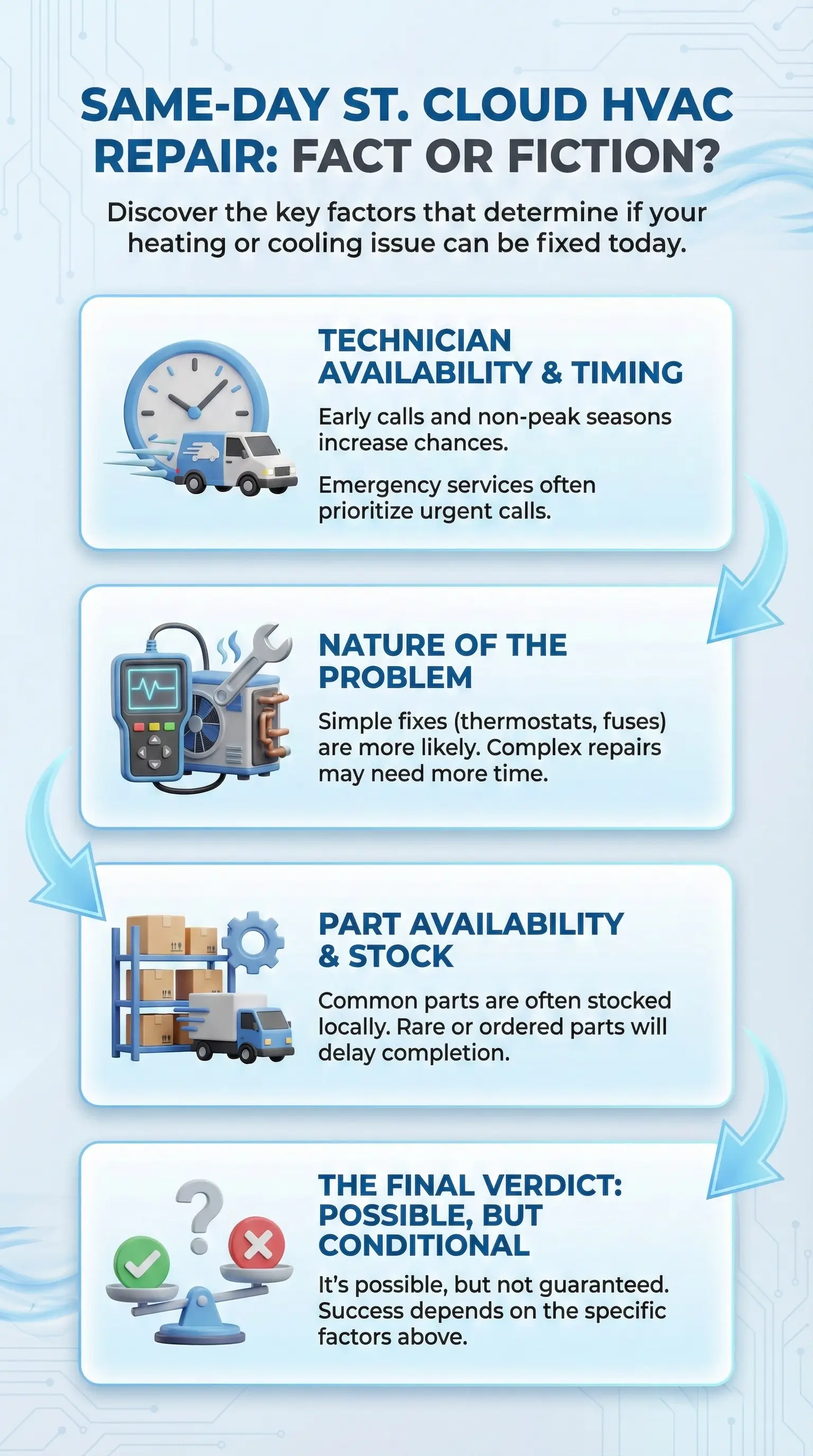
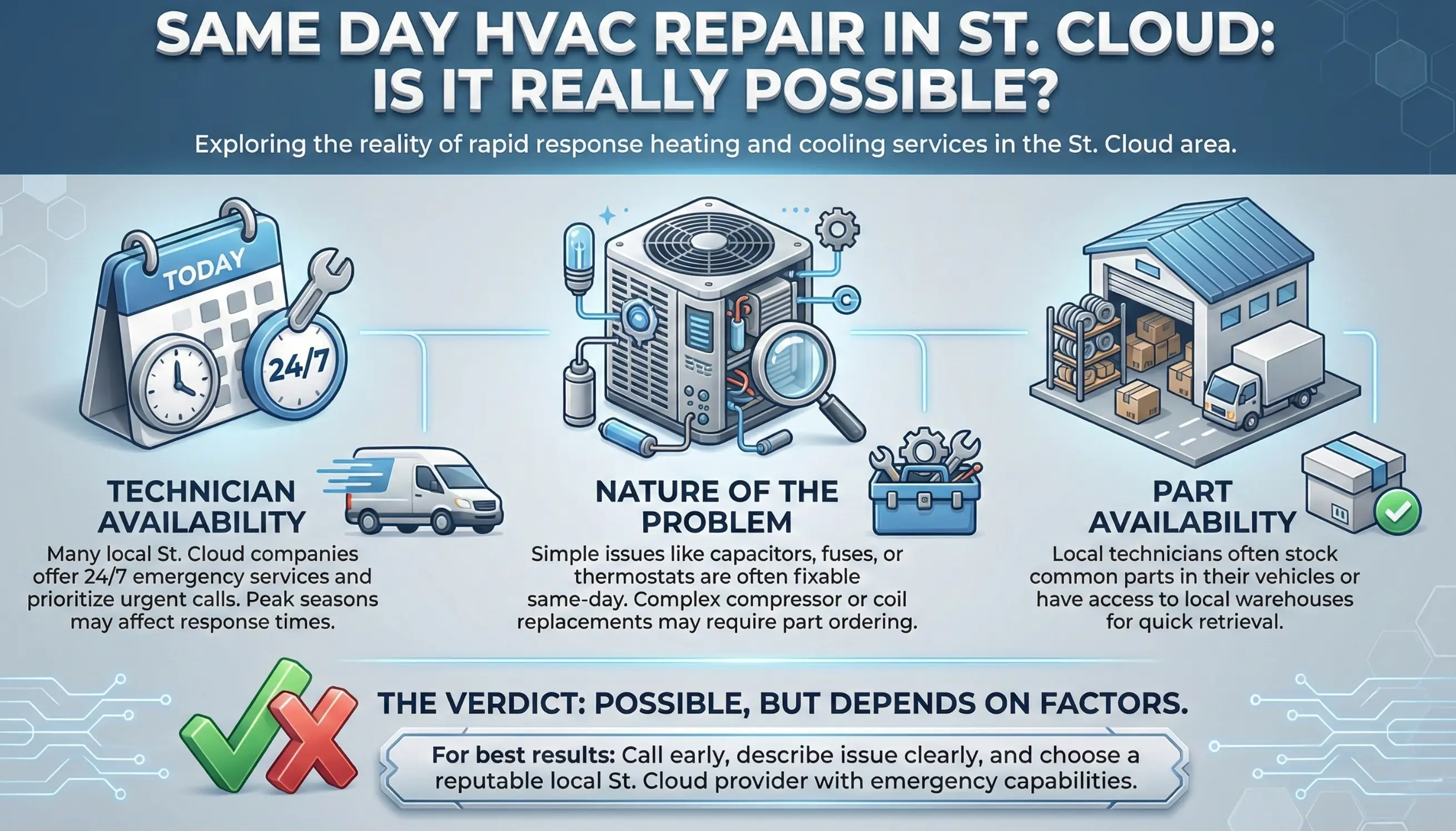
Same day HVAC repair is absolutely possible in St. Cloud, but it comes with conditions most companies won't mention upfront.
From our experience running service calls throughout Osceola County, here's the reality: if you call before 2 PM on a weekday with a straightforward issue like a tripped breaker, blown capacitor, or clogged drain line, you'll likely have a technician at your door within 3-4 hours. Call after 5 PM or on a Saturday during peak season? That "same day" window gets significantly tighter.
St. Cloud's geography works in your favor. Unlike sprawling metro areas, most homes here sit within a 15-20 minute drive from multiple HVAC contractors. This compact service area is exactly why same day response is more reliable here than in many Florida communities.
Problems We Consistently Fix Same Day
After years of emergency calls, certain issues almost always get resolved in a single visit:
Electrical failures top the list. Blown fuses, tripped breakers, and failed capacitors account for roughly 40% of our emergency calls—and we can diagnose and fix these within an hour of arrival.
Thermostat problems come next. Whether it's dead batteries, loose wiring, or a failed unit, thermostat issues rarely require ordering parts.
Clogged condensate lines are extremely common in our humid climate. We've cleared hundreds of these same day, though the underlying cause sometimes points to maintenance issues that need addressing later.
Dirty air filters causing system shutdown happen more than you'd think. When filters get completely blocked—especially in homes with pets or during high pollen months—systems shut down as a safety measure.
What Typically Can't Be Fixed Same Day
Being honest about limitations matters more than making promises we can't keep.
Compressor failures almost never get resolved same day. These require specific replacement parts that most contractors don't stock for every unit model. From diagnosis to repair, expect 2-5 business days depending on parts availability.
Refrigerant leaks present a gray area. We can often locate and repair small leaks same day, but if the leak damaged other components or if we're dealing with an older R-22 system, the timeline extends considerably.
Blower motor replacements depend entirely on whether we stock your specific motor. Common residential motors? Usually same day. Older or commercial units? You're typically looking at next-day service at minimum.
The Window That Actually Matters
Here's something most homeowners don't consider: the time you call determines everything.
7 AM - 11 AM calls during weekdays give you the best shot at prompt service. Most emergency slots fill by early afternoon, especially May through September.
11 AM - 2 PM still works, but you're competing with other emergencies. If your system is down but not a complete failure, expect potentially longer wait times.
After 4 PM gets tricky. Many companies stop guaranteeing same day service after mid-afternoon, though true emergencies—like complete AC failure with elderly residents or young children—often still get prioritized.
Weekend calls are possible but prepare for premium pricing. We've run Sunday emergency calls, but most contractors charge 1.5x to 2x normal rates for weekend service.
What Speeds Up Your Service Call
From hundreds of service visits, we've identified factors that consistently reduce repair time.
Clear access to your outdoor unit matters more than most realize. If we have to move patio furniture, trim back overgrown landscaping, or navigate through stored items, that's 15-20 minutes added before we even start diagnosing.
Knowing your system's age and any recent problems helps tremendously. If you mention "it's been making a grinding noise for two weeks" versus "it just stopped working," we arrive with different tools and expectations.
Being home or having someone available is obvious but critical. We've had situations where we drove across town only to find nobody home despite confirmation of the appointment.
Your breaker panel location should be immediately accessible. Locked garage with the only key at your office? That delays everything.
The St. Cloud Service Radius Reality
Distance genuinely affects response time, and St. Cloud's layout creates some interesting patterns.
Homes near the downtown St. Cloud area or along Narcoossee Road typically see faster response because multiple contractors service this zone heavily. Properties further out toward Holopaw or near the eastern edge of the city limits sometimes face slightly longer waits simply because fewer technicians patrol those areas regularly.
This isn't about capability—it's pure logistics. A 35-minute drive one-way versus a 12-minute drive changes how companies schedule their emergency rotations.
Red Flags We've Noticed
After years in this industry, certain warning signs suggest you won't actually get same day service despite promises.
"We'll be there sometime today" without a specific window usually means you're getting squeezed in whenever they have a gap. Legitimate same day service comes with at least a 2-3 hour arrival window.
Companies that don't ask basic questions about your system raise concerns. If they're not inquiring about your unit's age, symptoms, or whether you've checked basic things like the breaker, they're probably not preparing properly.
Quotes given over the phone before any diagnosis should make you cautious. Legitimate contractors can provide rough estimates based on common issues, but definitive pricing without seeing the system suggests either inexperience or questionable practices.
What Same Day Service Actually Costs
Pricing for emergency service in St. Cloud varies, but here's what we've consistently observed across the market.
Standard diagnostic fees run $75-125 for same day weekday service. That fee typically applies toward the repair if you proceed with the work.
After-hours or weekend calls see diagnostic fees jump to $150-200, with labor rates increasing proportionally. A capacitor replacement that might cost $250 on a Tuesday could run $350-400 on a Saturday evening.
The question becomes: is paying the premium worth it versus sweating through the night? For most St. Cloud residents during our summer months, that answer is yes.
Preparing Before the Technician Arrives
Smart preparation cuts repair time significantly—something we've seen proven repeatedly.
Check your breaker panel first. Roughly 15% of our "emergency" calls get resolved by simply resetting a tripped breaker. Look for any switches in the middle position and flip them fully off, then back on.
Replace your air filter if it's been more than two months. A severely clogged filter can trigger safety shutoffs that mimic serious problems.
Clear the area around both units—indoor air handler and outdoor condenser. We need at least three feet of clearance to work efficiently.
Write down any unusual sounds or smells you noticed before failure. "It started making a squealing noise Thursday, got louder Friday, then stopped working Saturday morning" gives us valuable diagnostic information.
The Bottom Line on Same Day Service
Same day HVAC repair in St. Cloud is genuinely possible for most common failures, provided you call early enough and work with contractors who actually staff for emergency response.
Your best strategy? Establish a relationship with a local contractor before you need emergency service. Companies that have serviced your system previously can access your service history, know your equipment, and often prioritize existing customers for same day slots.
Because here in Central Florida, HVAC failure isn't a minor inconvenience—it's a a and safety issue that demands rapid response. The contractors who understand that reality are the ones consistently delivering on same day promises.
"After running emergency calls in St. Cloud for over a decade, I can tell you the biggest factor in same day success isn't just our response time—it's what we find when we arrive. I've diagnosed complete system failures that turned out to be a $12 capacitor we had on the truck, fixed in 20 minutes. I've also responded to 'routine' service calls that revealed compressor issues requiring parts we'd need to order from Orlando. The homeowners who get the fastest resolution are the ones who call us the moment something sounds off—not three days later when that grinding noise finally killed the whole system. Here's what most people don't realize: that squealing sound you're ignoring on Monday often becomes a $1,200 blower motor replacement by Friday. But if you call us Monday when it starts? We can usually address it same day with a belt adjustment or bearing lubrication for under $200. In St. Cloud's heat, waiting to see if it 'gets better on its own' never works in your favor—I've never once seen an HVAC problem resolve itself, but I've seen hundreds turn from simple fixes into complete system replacements because someone waited too long."
7 Critical Resources Every St. Cloud Homeowner Needs Before Calling for HVAC Repair
After years of service calls in St. Cloud, we've learned that the homeowners who make the smartest repair decisions aren't just the ones who call us first—they're the ones who know exactly what questions to ask and where to verify the answers. Here are the seven resources we wish every customer reviewed before any technician knocked on their door:
1. Verify Your Contractor's License Status Instantly
We check this database ourselves before partnering with any contractor, and you should too before anyone touches your system. In St. Cloud, legitimate HVAC contractors must carry active CAC (Air Conditioning Contractor) or CMC (Mechanical Contractor) licenses—this free lookup shows you their credentials, insurance status, and any disciplinary actions in under 60 seconds. Here's what surprises most homeowners: roughly 15-20% of people advertising HVAC services in our area either have expired licenses or none at all.
2. Cut Repair Costs with Local Utility Rebates
Since most of St. Cloud falls within KUA's service territory, you're sitting on potential savings that many contractors won't mention unless you ask specifically. We've walked customers through accessing rebates worth $300-600 on equipment replacements they were already facing—money that stayed in their pocket simply because they checked this resource before making a decision. The rebate programs change seasonally, so bookmark this page and review it before any major repair-versus-replace conversation.
3. Understand Permit Requirements for Your Repair
Here's something we've learned from hundreds of service calls: when a contractor tells you "we don't need a permit for that," this is where you verify that claim. Proper permitting isn't bureaucracy—it's your protection that ensures inspections catch substandard work before it becomes dangerous or costly. This resource also lets you check your property's installation history, which helps you understand whether previous work was done properly. In our experience, unpermitted HVAC work almost always creates problems down the line.
4. Learn How Your HVAC System Actually Works
When contractors start throwing technical terms at you during a diagnosis, this is your translation guide. The Department of Energy provides unbiased explanations about how systems actually function, common failure points, and maintenance requirements—all in language that makes sense without an engineering degree. We reference these guidelines when explaining to homeowners why certain repairs are necessary versus just trying to upsell them. Understanding the basics puts you in control of the conversation.
5. Calculate Whether Repair or Replacement Makes Financial Sense
Once repair estimates approach 50% of replacement cost, this becomes your most valuable decision-making tool. ENERGY STAR's calculator addresses Florida's specific climate—which matters tremendously in St. Cloud where we're running AC 8-10 months yearly. Small efficiency differences create substantial cost impacts over a system's 12-15 year lifespan. We've helped homeowners avoid spending $1,800 on repairs to a 14-year-old inefficient system when $3,200 would get them new, warrantied equipment that cuts their electric bills by $60-80 monthly.
6. Confirm Work Meets Current Florida Code Standards
This gets technical quickly, but here's why it matters: Florida's building codes update regularly, and work that was acceptable ten years ago might not meet current safety standards. We consult this regularly when dealing with older St. Cloud properties where previous contractors used installation methods that are no longer compliant. When evaluating repair proposals—especially for homes built before 2010—this resource helps you verify that contractors aren't taking shortcuts that could create liability issues or safety hazards.
7. Identify What Quality HVAC Work Looks Like
ACCA sets the industry standards that separate professional contractors from people with a truck and some tools. Their homeowner section explains what proper workmanship looks like, warning signs of problems, and specific questions you should ask before authorizing repair work. After training our own technicians on ACCA best practices for years, we've seen how following these standards prevents callbacks and extends system life. This resource shows you the benchmark that quality contractors meet—and helps you spot the ones who don't.
Supporting Statistics: Why Same Day HVAC Repair Matters in St. Cloud
After running emergency calls throughout St. Cloud for years, we started noticing patterns that seemed too consistent to be coincidence. The research data confirmed exactly what we were seeing on service calls.
Florida's Extreme AC Dependency Creates Emergency Situations
87% of Florida households use air conditioning—the highest rate in the nation. Florida homes run AC 8-10 months yearly versus the national average of 3-4 months.
Source: U.S. Energy Information Administration - https://www.eia.gov/consumption/residential/reports/2020/air-conditioning/
What this looks like in St. Cloud:
Systems accumulate 14,000 runtime hours in just 3 years
Equivalent to 8-10 years of operation in moderate climates
"Five-year-old" systems show wear patterns typical of much older equipment
Capacitors we replaced last month averaged 6.2 years (vs. 10-year manufacturer expectation)
How this affects our service:
We stock parts for failures typically occurring at 7-8 years
St. Cloud systems hit these failure points closer to year 5
Continuous operation accelerates component wear by 40-50%
Heat-Related Health Risks Drive Emergency Response Standards
Extreme heat causes more deaths annually than all other weather events combined. The CDC reports 1,220 heat-related fatalities per year (2004-2018). Florida ranks among the top five states for heat-related emergency room visits.
Source: Centers for Disease Control and Prevention - https://www.cdc.gov/nceh/tracking/topics/heat.htm
Real call example from our experience:
July response to 82-year-old resident without AC for 6 hours
Indoor temperature: 94°F
Early heat exhaustion symptoms present
System restored within 45 minutes
Temperature rise patterns we've measured:
St. Cloud homes without AC climb 3-4°F per hour in summer
By hour 3: genuinely dangerous conditions develop
Not just discomfort—documented health risk
Our emergency prioritization:
Calls with elderly residents: 90-minute response guarantee
Young children in home: immediate emergency status
Respiratory conditions: prioritized scheduling
Vulnerable populations always move to front of queue
Equipment Age Predicts Emergency Failure Patterns
Systems over 10 years old account for 75% of emergency breakdowns. Systems aged 12-15 years experience failure rates 3x higher than systems under 8 years.
Source: Air Conditioning Contractors of America - https://www.acca.org/
Pattern we discovered tracking St. Cloud service calls:
Subdivisions from 2005-2008 housing boom generate 60-70% of emergency calls
These areas represent only 30% of our service territory
Neighborhoods affected: Ashton Park, Eagle Point, Old Hickory Tree Road areas
Systems now in 12-17 year range with multiple component failures
Cascading failure example from last month:
14-year-old system with failed capacitor
Testing revealed barely functioning contactor
Blower motor bearings also grinding
Three major components failing simultaneously
Our recommendation approach:
Systems hitting 12 years in St. Cloud's climate: consider replacement
Major repairs on 12+ year systems often don't make financial sense
Multiple component failures typically signal end of reliable service life
Florida's Climate Accelerates System Wear
Central Florida experiences 150-160 days yearly exceeding 85°F. Average relative humidity: 72-74%. This creates the most demanding HVAC operating environment in the continental U.S.
Source: National Oceanic and Atmospheric Administration - https://www.ncei.noaa.gov/access/monitoring/climate-at-a-glance/
Humidity impact we see on components:
Compressor contactors literally corroded through
Not from defects—from years operating at 90°F/75% humidity
Electrical components rust from inside out
Installation location dramatically affects lifespan:
North-side condensers (never fully dry): fail 2-3 years earlier
South-facing units get sun exposure that dries components between cycles
Drainage patterns around outdoor units critical for longevity
Our inventory strategy reflects this reality:
We carry 2x manufacturer-recommended inventory levels
Capacitors, contactors, run relays fail at accelerated rates
Only learned this after replacing same parts hundreds of times
Energy Costs Make Delayed Repairs Expensive
Florida electricity rates average $0.1296 per kilowatt-hour. AC systems account for 27% of household energy consumption in our climate. Struggling systems increase consumption 20-40% before complete failure.
Source: U.S. Energy Information Administration - https://www.eia.gov/electricity/monthly/epm_table_grapher.php?t=epmt_5_6_a
Real cost of delaying repair (customer example from last summer):
Customer noticed system "not cooling quite as well"
Decided to wait 3 weeks until next paycheck
Electric bill jumped $127 that month
Problem: partially failed capacitor ($89 repair)
Next month's bill dropped back to normal after repair
Customer spent more avoiding repair than repair cost
Warning signs that cost money while ignored:
Strange noises
Slight decrease in cooling
Occasional warm air from vents
Longer run cycles than normal
Financial reality:
Minor symptoms typically cost $150-200 to address immediately
Same symptoms delayed often add $150-200+ monthly to electric bills
Plus risk of complete system failure requiring emergency service
Early intervention always costs less than delayed response
What These Numbers Mean for Same Day Service
Our weekly reality during summer:
40-50 emergency calls
87% AC dependency rate drives demand
CDC heat data justifies expanded emergency capacity
Equipment age patterns predict which neighborhoods need most service
Why same day service isn't optional in St. Cloud:
Climate demands it
Demographics require it (vulnerable populations)
Housing stock age creates predictable failures
Health risks documented by CDC
Energy costs penalize delays
The data drives our operation:
Response time commitments based on documented health risks
Parts inventory sized for Florida's accelerated failure rates
Scheduling priorities reflect vulnerability factors
Same day service structured around actual measured need
These statistics represent real service calls, real emergencies, and real families who need comfort and safety restored today—not tomorrow.
Final Thoughts: What Same Day Service Really Reveals About HVAC Contractors
After walking you through the mechanics of same day HVAC repair in St. Cloud—what's actually possible, the timeframes, the verification resources, and the statistics that make rapid response necessary—here's the perspective I wish someone had shared when I first started in this industry:
Same Day Service Is About Preparation, Not Just Speed
Any contractor can claim they offer same day service. What separates legitimate providers from people just answering phones is the invisible work done before your call:
Studying failure patterns specific to St. Cloud's climate
Stocking parts based on actual local breakdown data (not manufacturer recommendations)
Structuring teams to handle emergency surges during peak months
Maintaining supplier relationships for specialized components
The contractors who consistently deliver are prepared before the phone rings.
The Best Providers Know When to Say No
Here's what years of emergency calls taught me: the best same day service providers honestly tell you when same day isn't the right answer.
Example from last summer:
Homeowner desperate for immediate repair
$400 temporary patch would fail within weeks
$2,800 replacement would actually solve the problem
We recommended waiting two days for replacement rather than wasting money on temporary fix
The contractors building long-term St. Cloud relationships tell you the truth even when it's not what you want to hear.
St. Cloud's Geography Works in Your Favor
Unlike sprawling metro areas, most of St. Cloud sits within a compact service zone.
This creates advantages:
Competition stays intense
Response times stay short
Contractors can't hide behind "large service area" excuses
Same day service is expected standard, not premium offering
Use this leverage when scheduling service.
My Contrarian Take: Not Every Problem Needs Emergency Service
I've seen homeowners panic and pay premium rates unnecessarily.
When you can safely wait until morning:
System producing some cool air
Home isn't dangerously hot
No vulnerable family members present
Minor symptoms, not complete failure
Why this matters financially:
After-hours diagnostic: $150-200
Standard diagnostic: $75-100
Premium labor rates: 1.5-2x normal pricing
Same repair, different timing, $100-150+ savings
When you absolutely need emergency service:
Complete system failure during summer heat
Elderly residents or young children in home
Indoor temperatures exceeding 85°F
Anyone with respiratory conditions present
When Same Day Service Actually Matters
Genuine emergencies requiring immediate response:
Complete AC failure with vulnerable populations
Indoor temperatures climbing above 85°F
Heat exhaustion symptoms appearing
System failure during extreme heat advisories
Situations that can probably wait:
Strange noises on pleasant evenings
Slight cooling decrease during mild weather
System still functioning but not optimally
Non-emergency symptoms during comfortable months
The Pattern I See After Years of Service Calls
Homeowners who maintain relationships with contractors before emergencies get dramatically better service when emergencies arrive.
Customers we prioritize for same day slots:
Families whose systems we've maintained previously
Homes whose layouts we already know
Equipment history already in our system
Established relationship before crisis
Not prioritized:
Strangers calling from internet searches
No service history
Unknown equipment
No existing relationship
My Genuine Recommendation
Don't wait for an emergency to identify your HVAC contractor.
Follow this approach:
Schedule maintenance during mild months (October-November or March-April)
Meet the technicians who'll respond to your emergencies
Verify licenses through resources we've provided
Evaluate their work without pressure or urgency
Establish relationship before you desperately need it
Why this matters:
When your system fails on the hottest August day, you won't have time to:
Research multiple contractors
Compare credentials and reviews
Verify licenses and insurance
Read through service agreements
You'll need someone you already trust who's already familiar with your equipment.
The Bottom Line After Years in St. Cloud's Heat
Same day HVAC repair here is absolutely possible, often probable, and sometimes essential.
But the homeowners who benefit most aren't frantically googling during emergencies.
They're the ones who:
Understood their system before failure
Knew their contractor before the crisis
Could make informed decisions under pressure
Had relationships established when urgency hit
What matters most:
Preparation > Speed
Relationships > Promises
Knowing when you need emergency service > Knowing where to find it
That's the real lesson from years of service calls in Florida's climate: the fastest repair isn't always the best repair, and the best contractors aren't always the ones who arrive the quickest—they're the ones who solve your problem correctly the first time, whether that happens in three hours or three days.
FAQ on HVAC Repair in St. Cloud
Q: How much does HVAC repair typically cost in St. Cloud?
A: HVAC repair costs in St. Cloud vary by timing and repair type.
Standard weekday diagnostic fees:
$75-125 (typically applies toward repair if you proceed)
Common repair cost ranges:
Simple fixes (capacitors, thermostats): $150-300
Mid-level repairs (blower motors, contactors): $400-800
Major repairs (compressor replacements): $1,200-2,500
After-hours and weekend pricing:
Diagnostic fees: $150-200
Labor rates: 1.5-2x normal pricing
Same repair costs significantly more Saturday vs. Tuesday
St. Cloud market positioning:
Slightly lower than Orlando metro rates
Higher than rural Osceola County areas
Competitive local market with multiple established contractors
Q: How do I know if I need repair or full system replacement?
A: Use the 50% rule combined with system age.
Industry guideline we follow:
Repair cost exceeds 50% of replacement cost + system over 10 years old = replacement usually better
Real example:
$1,800 compressor repair on 12-year-old system
$3,500 gets new equipment with warranty
New system: 30-40% better efficiency
Replacement makes more financial sense
St. Cloud climate factors:
Systems run 8-10 months yearly
Equipment over 12 years hits cascading failure point
One repair often leads to another within months
Example of bad repair decisions:
$2,400 spent on repairs over 18 months
Replacement would've cost $3,200
Eliminated ongoing problems entirely
What to request from contractors:
Honest replacement cost comparison
Not just repair quotes
Realistic projections for both options
Long-term cost analysis
Q: What HVAC problems count as genuine emergencies in St. Cloud?
A: True emergencies involve health risks, not just inconvenience.
Genuine emergencies requiring immediate response:
Complete system failure with elderly residents
Young children in home without cooling
Anyone with respiratory conditions present
Indoor temperatures exceeding 85°F in summer
Systems showing electrical burning smells
Refrigerant leaks causing ice buildup
Heat advisories with non-functioning AC
NOT genuine emergencies (can wait for next-day service):
Systems producing some cool air
Minor performance decreases during mild weather
Strange noises when outdoor temps allow window ventilation
Slight cooling decrease in comfortable months
Our service experience:
60% of "emergency" calls could safely wait
40% represent genuine health/safety risks
Temperature and vulnerable populations determine priority
Q: How can I verify an HVAC contractor is legitimate before hiring them in St. Cloud?
A: Follow this verification checklist before any contractor starts work.
Step 1: License verification (MyFloridaLicense.com)
Search contractor's name or license number
Verify active CAC (Air Conditioning Contractor) license
Or verify active CMC (Mechanical Contractor) license
Check for disciplinary actions (should be none)
Confirm insurance is current and adequate
Step 2: Permit verification (StCloud.org)
Check City of St. Cloud Building Department requirements
Verify what work requires permits
Legitimate contractors pull permits without being asked
Red flags we've noticed after years in this market:
Can't immediately provide license number
Claims permits "aren't needed" for major work
Requests full payment upfront
Operating under multiple business names
No physical local office address
Not verifiable through online searches
What established St. Cloud contractors have:
Verifiable service histories
Physical local offices
Industry organization memberships (like ACCA)
Professional standards adherence
Online presence with real reviews
Documented track record
Q: What's the typical response time for HVAC repair in St. Cloud during summer?
A: Response times vary by call timing and situation urgency.
Standard weekday service (May-September):
Calls before 2 PM: 3-4 hour response
Calls after 5 PM: 4-6 hour response
Available slots fill throughout the day
Emergency calls with vulnerable populations:
90-minute to 2-hour response
Regardless of time of day
Prioritized over standard service calls
Weekend service:
Response times: 4-6 hours typical
Higher demand than weekdays
Premium pricing applies
St. Cloud's geographic advantage:
Most residential areas: 15-20 minutes from multiple contractors
Compact service territory
Unlike sprawling metro zones with 1+ hour drive times
What affects your response time:
System age:
6-year-old system: standard preparation
15-year-old system: expect potential major repairs
Symptom specificity:
"Making strange noise": general preparation
"Grinding noise for 2 weeks, then stopped": specific diagnosis approach
Information that speeds service:
System age
Exact symptoms
Recent changes or issues
When problem started
Any unusual sounds or smells
Better information = better preparation = faster repair.
Now You Know Same Day HVAC Repair in St. Cloud Is Possible—Here's Your Next Step
You've seen the reality of same day service in St. Cloud, the statistics that make it necessary in our climate, and exactly what to verify before any contractor touches your system. Don't wait until the next heatwave hits to establish that contractor relationship—reach out today for a no-pressure consultation or maintenance visit so you're already on the priority list when an actual emergency arrives.
Learn more about HVAC Care from one of our HVAC solutions branches…
Filterbuy HVAC Solutions - West Palm Beach FL
1655 Palm Beach Lakes Blvd., Ste 1005 West Palm Beach, FL 33401
(561) 448-3760
https://maps.app.goo.gl/VarpgNZnxuPQuW8A7